
Highlights
- Very short payback & High ROI: Economic model driven by measured on-field operational efficiency.
- 50% Reduction in muscular and perceived effort: Significant reduction in shoulder and back strain (EMG measurements and Borg Scale)
- 10% Reduction in execution time: Measurable time savings on high-physical-demand tasks.
Background: the Dussmann field assessment
Can reducing physical strain also improve operational efficiency? While occupational exoskeletons are primarily designed to support workers during demanding tasks, their ergonomic value can directly translate into measurable business performance.
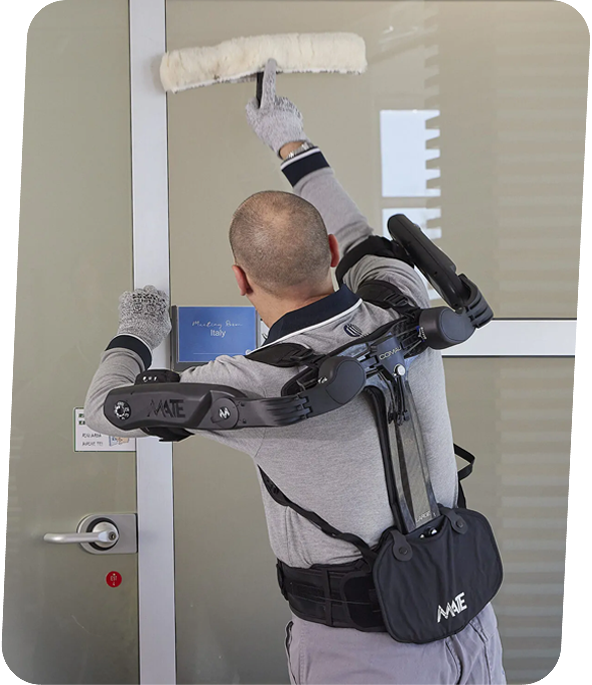
To explore this connection, an in-field assessment was conducted on MATE-XT GO during real industrial cleaning operations, combining ergonomic evaluations with standard industrial engineering methodologies:
- Dussmann provided the operational use cases and real working cycles.
- Valeo-in, an independent third party specializing in industrial engineering and time and motion study (“tempi e metodi”), conducted the execution-time analysis using established methodologies (MTM-UAS for normalized execution times and EAWS for biomechanical load).
- IUVO and COMAU handled technical coordination and ergonomic assessment.
This project marks the latest milestone in IUVO’s continuous path to validate upper-body exoskeletons in industrial cleaning.
IUVO’s on-field validation journey: Formula Servizi & long-term testing
The journey began in 2019 with an in-field validation in collaboration with Formula Servizi, where the impact of MATE exoskeletons in supporting daily cleaning activities was first proven and subsequently published in the peer-reviewed journal Applied Ergonomics.
The pathway continued in 2022 through a long-term field study involving a specialized team of workers. Over a 12-month monitoring period, daily use of the MATE exoskeleton demonstrated persistent efficacy, reducing physical strain by up to 50% over extended time.
Measurable results & business case
The assessment with Dussmann monitored 5 operators across more than 100 hours of active field use, tracking perceived effort (Borg Scale), musculoskeletal health, and cycle times:
- Ergonomic impact: A 20% reduction in perceived muscular effort in the shoulders and back, alongside lower frequency and intensity of upper limb and lower back discomfort.
- Operational efficiency: Tasks characterized by the highest biomechanical load saw standard execution times reduced by up to 12%.
- Business case: Factoring these efficiency gains into an economic model (accounting for labor costs and device lifecycle investment) demonstrates a very short payback period and a highly positive ROI.
The assessment proves that ergonomic support and operational performance are deeply connected: reducing biomechanical load directly translates into actionable operational value.
